
Introduction
The History of Heat
Aristotle, the Greek philosopher and scientist, proposed a theory of heat around 400 B.C. Aristotle’s theory of heat maintained that hot, wet, dry and cold conditions were formed through a combination of four substances. These four substances were fire, air, water and earth. For example, Aristotle believed that heat was obtained through a combination of fire and air. Although Aristotle had no scientific data to support his theory, it was the prevalent theory of heat for approximately 2000 years!
In the 1600’s, real experiments began to be performed concerning the nature of heat. As a result of these early experiments, there was a shift in belief to the Caloric Theory of Heat. The basis of this change in theory was a result of fifteenth century scientists noting that heat flowed from substances with a higher temperature to those with a lower temperature. At this point in history, scientists believed that caloric (heat) was an invisible fluid or form of matter. In this way, heat could move in or out of an object. When a warm object came into contact with a colder object, it was believed that the invisible fluid (caloric), moved from one substance to the other. Consequently, the warmer substance lost some of its caloric content, which resulted in a decrease in the warmer substance’s temperature and the cooler substance gained caloric, which resulted in an increase in temperature for the cooler substance. For example, when a person touched a piece of ice with his finger, it was believed that caloric flowed out of the body (through the finger) and into the piece of ice. This theory served to explain some of the mystery concerning heat, such as heat flows from substances with higher temperatures to a substances with lower temperatures. However, one major stumbling block to this theory was that later experiments revealed that the mass of the substances (i.e., a steel rod), did not change at different temperatures. This was important because if we believed a substance gained or lost caloric, then it would be expected that the mass of the object would change accordingly.
 In the late
eighteenth century, a British physicist Benjamin Thompson (later
known as Count von Rumford) remarked that a vast amount of heat was
generated while a cannon was being drilled, and doubted that an
invisible fluid (caloric) was responsible. Thompson, along with a
British chemist Sir Humphrey Davy (through his own research)
maintained that heat was much like work, in that it is a form of
energy (related to motion) in transition. Evidence to support these
suggestions was presented by the British physicist James Prescott
Joule (in 1849). Through a series of well planned and carefully
executed experiments, Joule conclusively demonstrated the ideas of
Thompson and Davy. The modern theory of heat will be discussed in
greater detail in class and in this website.
In the late
eighteenth century, a British physicist Benjamin Thompson (later
known as Count von Rumford) remarked that a vast amount of heat was
generated while a cannon was being drilled, and doubted that an
invisible fluid (caloric) was responsible. Thompson, along with a
British chemist Sir Humphrey Davy (through his own research)
maintained that heat was much like work, in that it is a form of
energy (related to motion) in transition. Evidence to support these
suggestions was presented by the British physicist James Prescott
Joule (in 1849). Through a series of well planned and carefully
executed experiments, Joule conclusively demonstrated the ideas of
Thompson and Davy. The modern theory of heat will be discussed in
greater detail in class and in this website.
The Particle Theory
The particle theory consists of five main points:
1) All forms of matter are made up of particles;
2) All particles are in constant motion;
(This may be a difficult concept to conceptualize, especially when considering something in the solid state, such as wood or steel. However, it is important to know that even though we can not detect movement with the naked eye, the particles within the solid are moving constantly.)
3) The attractive forces between particles increase with proximity;
(This simply indicates that the attractive forces, the forces that exist between two particles - which pull the particles towards each other - increase as the particles move closer towards each other.)
4) Particles of a pure substance are all identical;
(When considering this point, start with the materials listed in the periodic table. A 5 mg (milligram) piece of Magnesium would be made up of particles that are all the same.)
5) The spaces between the particles are large compared to the size of the particles
themselves.
Heat And Temperature
The Kinetic Theory
In the nineteenth century, scientists continued experiments dealing with the nature of heat. Scientists such as Benjamin Thompson, Sir Humphry Davy and James Prescott yielded much insight into the modern theory of heat. One of their findings was that heat always moves from matter at an increased temperature to matter at a lower temperature, which raises the temperature of the latter and decreases the temperature of the former (assuming that the volume of the substances stays constant).
Under no circumstances does heat flow from a lower temperature substance to a higher temperature substance, unless some other form of work (energy) is being exerted on the substances. Specifically, heat is described as the energy of molecular motion (
Kinetic Theory) which may be summarized as:1) All matter consists of tiny particles which are called molecules;
2) The molecules of a substance are in constant motion and this motion is a form of energy called kinetic energy.
3) When a substance is heated, the speed of the molecules increases. This corresponds with an increase in kinetic energy.
The Kinetic Theory describes the effects of heat energy. One example of this occurs when the tip of a pin is sterilized using a flame. When the tip of the pin is exposed to the heat of the flame, the molecules in the tip of the pin begin to vibrate more quickly. This increase in vibration speed is an increase in kinetic energy. As these molecules in the tip vibrate at a higher speed, they collide with other molecules. When a molecule is involved in a collision it will also begin to vibrate at a higher speed. As the molecules collide with each other, the increase in kinetic energy is transferred along the length of the pin.
Eventually, all of the molecules in the pin will be vibrating at a higher speed and the pin will be too hot to hold in your hand.
Temperature
Now that heat is understood, the concept of temperature may be described as the measurement of the average amount of movement per molecule in a substance. It is important to note that temperature is an average because within any substance there is variation in the speed of the molecules. As outlined in the Kinetic Theory, molecules with a higher speed have more kinetic energy (heat). This corresponds to a higher temperature than molecules with a lower speed because the average amount of movement per molecule is greater.
 The
Difference Between Heat and Temperature
The
Difference Between Heat and Temperature
Therefore, heat and temperature refer to different concepts. Temperature is a property of the molecules in a substance and how fast they move. Heat is the energy flow to or from a substance because of a difference in temperature. Consider a simple observation that illustrates the difference between heat and temperature. Fill a coffee cup up with hot water. Then fill a teaspoon with the same water. Use a thermometer to take the temperature of the water in the coffee cup and the teaspoon. Let us pretend that the temperature was 70 degrees C in each. The water in the coffee cup and the spoon have the same temperature, but do not have the same amount of heat energy. One way this is proven is, imagine you had spilled the teaspoon of hot water on your pants. It may hurt for a moment, but more than likely, it would be no big deal. However, if you spilled the coffee mug of hot water on your leg, you could end up with some very serious burns. Another way of distinguishing between the differing amounts of heat energy between the coffee cup and the spoon would be to continue measuring and recording the temperatures of the water over a period of 15 minutes. You should quickly notice that the temperature of the water in the spoon is decreasing much faster than the temperature of the water in the coffee cup.
Calculating Heat Energy
The amount of heat energy contained within any substance is dependent upon three factors:
1) The temperature of the substance;
For example, one cup of water at 60 degrees C contains more heat energy than a cup of water at 10 degrees C.
2) The mass of the substance;
For example, 10 kg of steel at 10 degrees C contains more heat energy than 1 kg of steel at 10 degrees C.
3) The type of substance.
For example, 1 kg of water at 10 degrees C contains more heat energy than 1 kg of aluminum at 10 degrees C.
Units Of Heat And Temperature
Units of Heat
The primary unit of heat energy (metric system) is the joule, which is named after the scientist James Prescott Joule. A joule is defined as the energy required per second to force an ampere of current through one ohm of resistance. This energy can be measured because in this case it is converted to heat with 100% efficiency. Another way to define a joule is, the energy required to lift a mass of one Newton (1N or 100g), one metre (1m).
Heat is also commonly measured in units called calories. A calorie is defined as the amount of heat required to raise the temperature of one gram of water at a pressure of one atmosphere from 15 to 16 degrees Celsius. One calorie is equivalent to approximately 4.19 joules. A Calorie, take note of the capital C, is 1000 calories and should be referred to as a Kilocalorie. However, food manufacturers quite frequently label their products with the word Calorie. Check your food labels! A Kilocalorie is the amount of heat required to raise the temperature of one Kilogram of water at a pressure of one atmosphere from 15 to 16 degrees Celsius.
Units of Temperature
Concerning temperature, there are five scales of measurement. However, only three of these scales are commonly in use in the classroom today:
1) Celsius Scale (C)
The most widely used scale in the world and specifically in science. Using this scale, water has a freezing point of 0 degrees C and a boiling point of 100 degrees C.
2) Kelvin Scale (K)
This scale is the most commonly used thermodynamic scale. It defines the absolute zero of temperature, 0 K, as -273.15 degrees C. Therefore, 0 on the Celsius scale corresponds to 273.15 K.
3) Fahrenheit Scale (F)
This scale is still frequently used in English-speaking countries and is based on the mercury thermometer. Using this scale, water has a freezing point of 32 degrees F and a boiling point of 212 degrees F.
Changes of State
There are three states of matter solid, liquid and gas. These three states or phases of matter are regulated by heat energy. In general, all substances contract when they are cooled and expand when they are heated. It is important to note that the size of the molecules do not change, it is the space in between the particles which increase or decrease. In the solid state, the molecules are packed very tightly and move very little (relative to the other states). In the liquid state the molecules are farther apart than those in the solid and move a little faster. It is in the gaseous state that the molecules move the fastest and are the farthest apart. Changes between these states occur as a result of the addition or removal of heat energy. Specific temperatures and pressures are associated with the changes of state for pure substances. There are six possible instances during which a substance may change state. The six instances either yield or absorb energy.
A. When the Change of State Yields Energy
The transformation from a gas to a liquid state is called condensation. An example of this is water drops forming on a pane of glass separating a warm classroom and the cold outdoors. The transformation from a gas directly to a solid state is called sublimation.
The transformation of a liquid to a solid is called solidification. For all three of these cases the change of state yielded energy (in the form of heat) because the substance moved from a state with a higher kinetic energy (higher molecular motion), to one of lower kinetic energy (lower molecular motion).
B. When the Change of State Absorbs Energy
The transformation of a solid to a liquid is called melting. An example of this is the melting of an ice cube. The transformation of a solid directly to a gas is called sublimation. The transformation of a liquid to a gas is termed evaporation. In all three of these cases the change of state absorbed energy (in the form of heat) because the substance moved from a state with a lower kinetic energy (lower molecular motion), to one of higher kinetic energy (higher molecular motion). The amount of heat required to yield a change of state, without increasing the temperature, is called latent heat.
Sources of Heat Energy
Heat is a form of energy that cannot be created or destroyed. It is produced through the conversion of some other energy form. In all of the proceeding forms of energy, energy is converted into heat energy through an increase in molecular motion.
Mechanical Energy
 Mechanical
energy can be defined as the total potential and kinetic energy in a
moveable object. Friction is the most common type of force that can
be applied to produce heat energy. Friction is caused when two
substances rub against each other. When friction occurs, the
molecules on the surface of the substances that are being rubbed
together speed up. This causes an increase in kinetic energy and
temperature. An example of friction producing heat energy is when we
rub our hands together on a cold day to warm them up.
Mechanical
energy can be defined as the total potential and kinetic energy in a
moveable object. Friction is the most common type of force that can
be applied to produce heat energy. Friction is caused when two
substances rub against each other. When friction occurs, the
molecules on the surface of the substances that are being rubbed
together speed up. This causes an increase in kinetic energy and
temperature. An example of friction producing heat energy is when we
rub our hands together on a cold day to warm them up.
Distortion is the second type of force that can be applied to a substance to produce heat energy. Distortion occurs when a substance is forced to change shape. An example you can perform to exhibit distortion is to bend a piece of a coat hanger in the same spot for a few minutes. After a few minutes feel the spot where the bending was occurring, you should notice that there was an increase in temperature.
Compression is the third type of force which can be applied to a substance to produce heat energy. Compression involves squeezing the molecules of a substance into a smaller space. Of the states of matter, gases are the only visible form of compression. This is what happens when a balloon is filled with air. As more air is forced into the balloon, the temperature increases. As explained by the Kinetic Theory, when the molecules are in a closer proximity, they will collide more frequently and increase in motion.
Electrical Energy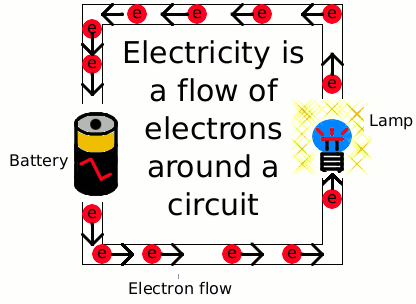
Electrical energy is a big part of every Canadian’s life. Any appliance that contains heating coils or elements is a source of heat energy (i.e., space heaters, stove top). As the electrical current flows through the heating coil, the molecules within the coil are pushed to vibrate. In the case of a stove top, the amount of heat energy produced is controlled by the strength of the current introduced to the coil. To obtain a higher temperature, set the dial on the stove top to a higher temperature and a stronger current is introduced.
Chemical Energy
 Chemical
energy is transformed into heat energy through burning. Examples of
chemical energy sources are gasoline, oil, and propane. When these
fuels are burned, the chemical energy stored within the fuels are
released in the form of heat. When these fuels are introduced to a
catalyst (i.e., fire), the molecules begin to move faster and
combustion takes place (in the case of the fuels mentioned).
Chemical
energy is transformed into heat energy through burning. Examples of
chemical energy sources are gasoline, oil, and propane. When these
fuels are burned, the chemical energy stored within the fuels are
released in the form of heat. When these fuels are introduced to a
catalyst (i.e., fire), the molecules begin to move faster and
combustion takes place (in the case of the fuels mentioned).
Radiant Energy
Radiant energy takes the form of waves emitted from a hot substance. The sun is anexample of a radiant energy source. Radiant energy waves are emitted from the sun which cause the molecules in our skin to speed up when they come into contact with the rays. This results in an increased kinetic energy and a warm feeling on our skin. The sun is a very cheap source of energy, and it is a modern reality that scientists are continually striving for new ways to capitalize on this form on energy.
Nuclear Energy
The sun is an example of nuclear fusion in which four atoms of the element hydrogen fuse to produce a single atom of helium. During this process a small amount of the mass of the atoms is converted into a large amount of heat energy.
A second type of nuclear energy can be produced on earth. Nuclear fission is a process where atoms are split apart. During the splitting the atoms release a great deal of heat energy.
The Transfer of Heat
As stated earlier, heat energy flows from substances with a higher temperature to those with a lower temperature, as long as no other form of work is being exerted on the system. There are three ways in which heat can be transferred from one substance to another: conduction, convection and radiation.
Conduction
Conduction occurs when heat energy is transferred from one molecule to another through their movement and collisions. The example of heating a pin, where the molecules collide with each other, increasing kinetic energy and moving up the pin is an example of conduction. Materials that are able to conduct heat, or are efficient at conducting heat, are called heat conductors. In general, most metals are good conductors of heat energy (i.e., copper). Materials that are not able to efficiently conduct heat energy are called insulators. An example of an insulator is Styrofoam, which is why it is used to make cups for keeping drinks cold or hot.
Convection
 Convection
only occurs in gases and liquids. Convection involves the transfer
of heat energy from a warmer area to a cooler area. An example of
conduction occurs when a pot of water is allowed to boil on the
stove. The water molecules closest to the bottom of the pot, near
the heat source, will heat up more quickly and then rise to mix with
the cooler water on the top. In this way, convection currents are
established.
Convection
only occurs in gases and liquids. Convection involves the transfer
of heat energy from a warmer area to a cooler area. An example of
conduction occurs when a pot of water is allowed to boil on the
stove. The water molecules closest to the bottom of the pot, near
the heat source, will heat up more quickly and then rise to mix with
the cooler water on the top. In this way, convection currents are
established.
Another example of convection one may consider is the care taken in heating homes. In many homes there are ceiling fans, to offset the rise of hot air (force it back down).
Radiation

As described earlier, the sun emits waves of radiant energy, some of which penetrate the earth’s atmosphere and are absorbed in the form of heat energy. Even our bodies emit radiant energy, and this is one of the reasons people will often huddle together when they are cold.